
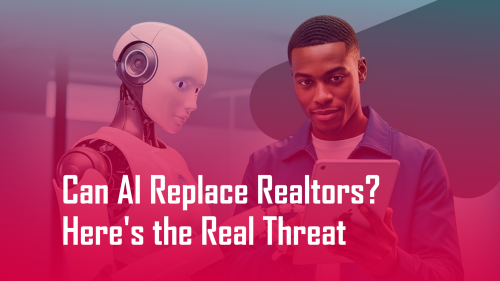
Can AI Replace Realtors? Here’s the Real Threat
Artificial Intelligence has become one of the most disruptive forces across industries worldwide. From finance and healthcare to education and marketing, AI is changing how professionals work, make decisions, and deliver value.
Real estate is no exception.
In 2026, property searches can be automated. Listings can be generated by AI tools. Virtual tours are becoming more sophisticated. Chatbots answer inquiries instantly. Market data can be analyzed within seconds. Property recommendations are increasingly personalized through algorithms.
These developments have sparked an uncomfortable question within the industry:
Can AI replace realtors?
For many professionals, this question creates anxiety. For others, it creates excitement. But perhaps the more important question is not whether AI can replace realtors.
The real question is:
What kind of realtor is actually at risk?
The answer reveals that the greatest threat is not artificial intelligence itself. The real threat is remaining unchanged in an industry that is rapidly evolving.
AI Is Already Entering Real Estate
Artificial intelligence is no longer a future conversation. It is already part of modern real estate operations.
Today, AI tools can:
- Write property descriptions
- Analyze market trends
- Recommend properties based on buyer preferences
- Automate customer responses
- Schedule appointments
- Generate marketing content
- Predict pricing trends
- Organize client data
- Improve advertising performance
Many tasks that previously required hours of manual effort can now be completed within minutes.
This naturally creates concern among professionals whose work depends heavily on those tasks.
However, understanding what AI can do is only part of the conversation.
Understanding what it cannot do is equally important.
Real Estate Is Not Only an Information Business
One reason people assume AI can replace realtors is because they misunderstand the profession.
If a realtor's job is simply uploading listings, sending brochures, and opening doors during inspections, then technology may eventually handle much of that work.
But professional real estate goes far beyond information distribution.
Real estate is fundamentally a relationship business.
Clients are not only buying information. They are buying:
- Trust
- Confidence
- Guidance
- Negotiation support
- Risk assessment
- Emotional reassurance
- Market interpretation
- Human judgment
Property decisions often involve significant financial, emotional, and personal consequences.
These decisions rarely happen through information alone.
They happen through conversations, trust, and confidence.
The Average Realtor Is More Vulnerable Than the Exceptional One
AI is unlikely to eliminate top-performing professionals.
However, it may significantly impact average, low-value service providers.
Professionals whose entire value proposition consists of:
- Sharing listings
- Forwarding information
- Repeating basic market facts
- Sending property videos
- Relaying messages between parties
may find themselves increasingly competing with technology.
This is because AI performs repetitive and information-based tasks extremely well.
The future market may not eliminate realtors.
It may eliminate certain types of realtors.
Clients Still Need Human Judgment
Property transactions involve uncertainty.
Buyers ask questions such as:
- Is this developer trustworthy?
- Is this location likely to appreciate?
- Should I buy now or wait?
- Is this price reasonable?
- What risks should I consider?
- Which option best fits my goals?
These questions require context, experience, and judgment.
AI can provide data.
It cannot fully understand human emotions, personal priorities, family considerations, cultural influences, or individual risk tolerance.
Two buyers with identical budgets may require entirely different advice because their goals, fears, and circumstances differ.
This is where human expertise remains valuable.
Negotiation Is Still Deeply Human
One of the strongest protections against replacement is negotiation.
Real estate negotiations involve:
- Emotions
- Timing
- Trust
- Personality dynamics
- Cultural understanding
- Relationship management
A successful negotiation often depends on reading body language, understanding hesitation, managing conflict, and building confidence.
These are deeply human skills.
Technology may assist negotiation processes, but genuine human interaction remains difficult to automate.
Particularly in high-value transactions, clients continue to seek experienced advisors who can navigate complex conversations.
Emotional Intelligence Cannot Be Easily Automated
Buying property is rarely a purely rational decision.
Clients experience:
- Fear of making mistakes
- Excitement about ownership
- Family pressures
- Financial anxiety
- Lifestyle aspirations
- Investment concerns
Realtors often function as emotional guides during these moments.
They reassure uncertain buyers, calm nervous investors, manage expectations, and help clients navigate difficult decisions.
Artificial intelligence can answer questions.
It cannot genuinely understand human emotion.
This makes emotional intelligence one of the most valuable skills in modern real estate.
Technology Is Creating Better Realtors
Rather than replacing professionals, AI is increasingly becoming a productivity tool.
Modern realtors can now use AI to:
- Create marketing materials faster
- Analyze market information
- Improve lead follow-up
- Generate content
- Automate administrative tasks
- Research buyer trends
- Organize client communication
This allows professionals to spend less time on repetitive tasks and more time on relationship-building, strategy, and client service.
The real advantage belongs to professionals who combine technology with human expertise.
The Future Realtor Will Look Different
The realtor of 2030 may look very different from the realtor of 2020.
Future professionals will likely function more as:
- Advisors
- Consultants
- Negotiators
- Market interpreters
- Investment guides
- Relationship managers
Routine administrative work may continue to decline.
Strategic and human-centered work will become increasingly valuable.
This means the industry is not disappearing.
It is evolving.
The Real Threat Is Lack of Adaptation
History shows that technology rarely destroys entire professions.
Instead, it transforms them.
Photography did not eliminate artists.
Online banking did not eliminate financial advisors.
Digital marketing did not eliminate marketers.
Technology typically removes low-value activities while increasing demand for higher-value expertise.
Real estate appears to be following the same pattern.
The professionals most at risk are those who refuse to learn, adapt, and evolve.
The professionals most likely to succeed are those who embrace technology while strengthening uniquely human skills.
Why Education Matters More Than Ever
As the industry changes, continuous learning becomes essential.
Modern real estate professionals need knowledge in areas such as:
- Digital marketing
- Buyer psychology
- Negotiation
- Investment analysis
- Technology adoption
- Market intelligence
- Client relationship management
This is why institutions like the School of Estate and Business are becoming increasingly important.
The future of real estate will belong to professionals who understand both technology and human behavior.
The School of Estate and Business equips professionals with practical, market-driven skills that prepare them for the realities of modern real estate, where knowledge, adaptability, and professionalism are becoming increasingly valuable.
So, Can AI Replace Realtors?
The answer is both yes and no.
AI may replace certain tasks.
It may reduce the need for purely transactional activities.
It may eliminate some repetitive functions.
But it is unlikely to replace professionals who create genuine value through expertise, trust, judgment, emotional intelligence, and strategic guidance.
The greatest threat is not artificial intelligence.
The greatest threat is becoming the type of realtor whose entire value can be automated.
The Future Belongs to Human Experts Who Use Technology
Artificial intelligence is not coming for every realtor.
It is raising the standard of what clients expect.
The industry is moving toward professionals who combine technological efficiency with human expertise.
Those who rely solely on listings, information, and basic transactions may struggle.
Those who build advisory skills, understand clients deeply, and leverage technology intelligently may become more valuable than ever.
The future will not belong to AI alone.
It will belong to the professionals who learn how to work alongside it.
Because in real estate, trust, judgment, and human connection remain difficult things to automate.
