
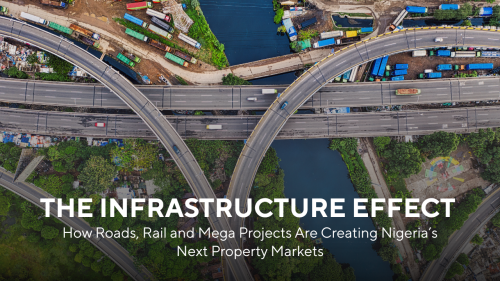
The Infrastructure Effect: How Roads, Rail and Mega Projects Are Creating Nigeria’s Next Property Markets
For generations, one of the first lessons taught in real estate has been simple: location matters.
But in today's Nigerian property market, location is no longer a fixed advantage.
It can change.
A community that was once considered too far from the city can become attractive after a major road is completed. An area that struggled with accessibility can gain new relevance when rail connectivity improves. A quiet coastal corridor can become an investment destination when ports, industrial facilities and large-scale commercial projects begin to take shape.
This is the infrastructure effect.
Across Nigeria, major roads, rail projects, airports, ports, industrial zones and urban development projects are changing the way people move, work, live and invest.
And wherever movement and economic activity change, real estate usually responds.
The important question for investors, however, is not simply where infrastructure is being developed.
It is:
What will that infrastructure make possible?
That question can reveal opportunities long before a location becomes an established property hotspot.
The Connection Between Infrastructure and Property Value
Real estate does not exist in isolation.
A piece of land becomes more useful when people can reach it easily. A commercial property becomes more valuable when customers, employees and suppliers can access it. Residential property becomes more attractive when residents can conveniently connect to work, schools, healthcare, shopping and other essential services.
This is why infrastructure can influence property values.
The relationship often looks something like this:
Infrastructure → Accessibility → Economic Activity → Population Growth → Property Demand → Development
A new road may initially seem like a transportation project.
But that road can reduce travel time.
Reduced travel time can encourage businesses to expand.
Businesses create jobs.
Jobs attract workers.
Workers need housing.
Housing creates demand for schools, retail, healthcare, hospitality and other services.
Developers then respond to the growing demand.
What began as a road project can eventually transform an entire property market.
That is the bigger picture investors need to understand.
Lekki-Epe: What Happens When Infrastructure Meets Economic Growth
Few areas demonstrate the relationship between infrastructure and real estate as clearly as the Lekki-Epe corridor.
The corridor has experienced significant transformation over the years, driven by road expansion, residential development, industrial activity, logistics infrastructure and major private and public sector projects.
The Lekki-Epe Expressway has played a major role in improving connectivity across the corridor, while developments around the Lekki Free Zone, Lekki Deep Sea Port and Dangote Refinery have introduced a much larger economic dimension to the area.
The significance of these projects goes beyond the physical structures themselves.
They create economic activity.
The Lekki Free Zone is designed as a major industrial and commercial hub. The Lekki Deep Sea Port strengthens Lagos' position as a logistics and maritime centre. Large-scale industrial facilities create employment and attract businesses that need warehouses, offices, accommodation, retail services and supporting infrastructure.
And where businesses and jobs go, people follow.
That creates another layer of demand for real estate.
Residential developments begin appearing around employment centres. Commercial properties become more attractive. Hospitality businesses emerge. Logistics facilities become increasingly valuable.
This is how infrastructure can gradually transform a location from a peripheral market into an important economic corridor.
Ibeju-Lekki: When a Location Moves From “Far” to “Strategic”
Ibeju-Lekki provides another important lesson.
For years, many investors viewed the area primarily through the lens of land banking.
The strategy was relatively simple: acquire land at an early stage, hold it, and wait for development to catch up.
But the investment story has become more complex.
With major industrial and logistics projects developing across the wider corridor, Ibeju-Lekki is increasingly being considered within the context of Lagos' expanding economic geography.
The important shift is not simply that property prices may rise.
It is that the reason for demand is becoming stronger.
A property market becomes more sustainable when people have a reason to live, work or conduct business there.
Industrial development can provide that reason.
Infrastructure can provide the connection.
And population growth can reinforce the demand.
This is why investors should pay attention to the economic activity surrounding a property rather than focusing solely on the property's current price.
But Here Is Where Investors Often Get It Wrong
Infrastructure can create opportunity, but it can also create hype.
The announcement of a major road, airport, rail line or industrial project can immediately trigger speculation.
Land sellers begin advertising properties as “close to the proposed project.”
Prices rise.
Investors rush in.
But an infrastructure announcement is not the same thing as infrastructure delivery.
And even when a project is completed, proximity alone does not guarantee appreciation.
A property can be close to a major road and still have poor access.
It can be located near an airport but face environmental or planning limitations.
It can be within a developing corridor but have questionable title.
It can be surrounded by infrastructure but have little genuine demand.
This is why sophisticated investors ask more questions.
What is actually being built?
Where exactly is it located?
What stage is the project at?
Who is funding it?
What economic activity will it generate?
How will it affect this specific property?
What risks could prevent the expected growth?
That is the difference between investing based on infrastructure and simply speculating on infrastructure.
Rail Is Changing the Meaning of Distance
Roads are not the only infrastructure influencing Nigeria's property market.
Rail has the potential to fundamentally change how Nigerians think about distance.
For many residents, the biggest challenge with living outside major commercial centres is not necessarily the distance itself.
It is the time required to travel that distance.
Reliable rail transportation can change that equation.
If people can live farther from their workplace while maintaining a predictable commute, previously less attractive residential locations can become more viable.
Lagos offers an important example with the development of its rail network.
The Lagos Rail Mass Transit system is designed to improve movement across major parts of the metropolis, with the Blue Line connecting the Marina axis to Mile 2 and the Red Line designed to connect areas including Agbado, Ikeja and Marina.
As transport networks expand, real estate opportunities can increasingly develop around stations and transit corridors.
This creates the potential for transit-oriented development, where residential, commercial and mixed-use projects grow around major transportation infrastructure.
For investors, this means the question is no longer simply:
“How far is this property from the city centre?”
It becomes:
“How easily can people move between this property and the places that matter to them?”
That is a much more useful question.
Airports Can Create More Than Passenger Traffic
Airports are another example of infrastructure with a significant real estate multiplier effect.
An airport creates demand beyond flights and passengers.
It can stimulate:
-
Hotels and serviced apartments
-
Office spaces
-
Retail and restaurants
-
Logistics and warehousing
-
Transportation services
-
Staff accommodation
-
Short-let properties
-
Commercial developments
This is why airport development can change the economic profile of surrounding areas.
But again, investors must distinguish between an airport that has been announced and one that has secured meaningful funding, approvals and implementation.
Real estate decisions should be based on e vidence rather than headlines.
Ports and Industrial Zones Can Reshape Entire Communities
Ports and industrial zones are particularly powerful because they can create sustained economic ecosystems.
A port needs logistics companies.
Logistics companies need warehouses.
Warehouses need roads.
Businesses need offices.
Workers need housing.
Businesses and residents need schools, healthcare, restaurants, retail and other services.
This creates a chain reaction.
Nigeria's growing industrial and logistics corridors therefore deserve close attention from property investors.
The opportunity is not necessarily in buying the property closest to the project.
It may be in identifying the second and third layers of demand that emerge around it.
That is where market knowledge becomes important.
The Lagos-Calabar Coastal Highway and the Question of Emerging Corridors
Large-scale transportation projects can also influence investor expectations across wider geographic areas.
The Lagos-Calabar Coastal Highway is one such project.
Beyond improving connectivity, the broader significance of a coastal highway lies in its potential to strengthen connections between communities and economic centres along the route.
For property investors, projects like this can create interest in previously less accessible locations.
But again, the smart approach is not to assume that every location along a proposed route will automatically become a property hotspot.
Investors need to examine the actual route, access points, surrounding development, land use, title, environmental conditions and economic activity.
Infrastructure is a catalyst.
It is not a guarantee.
What About Cities Outside Lagos?
The infrastructure-property relationship is not unique to Lagos.
Nigeria's other major cities are also experiencing infrastructure expansion, urban growth and increasing demand for housing and commercial property.
Abuja continues to expand into new districts and satellite communities.
Ibadan is benefiting from improved regional connectivity and its relationship with Lagos.
Port Harcourt remains an important economic centre with significant industrial and commercial activity.
Emerging cities and regional corridors can also benefit when improved infrastructure connects them to larger economic networks.
For investors, this presents an important opportunity.
The next major property story may not always be in the most expensive neighbourhood today.
It may be in the location that is becoming more economically connected.
Five Things Investors Should Look For
Infrastructure-led investment requires more than simply following announcements. Here are five things investors should watch.
1. Accessibility
How easily can people actually reach the property?
A major highway nearby means little if the property itself is difficult to access.
2. Economic Activity
What businesses, industries or institutions are moving into the area?
Economic activity creates sustainable demand.
3. Population Movement
Are people actually moving into the area?
Population growth is one of the strongest indicators of future housing demand.
4. Infrastructure Quality
Is the infrastructure reliable and usable?
A proposed road is different from a completed road. A planned rail line is different from an operational one.
5. Property Fundamentals
Never allow an infrastructure story to make you ignore the fundamentals.
Check:
Title.
Zoning.
Planning approvals.
Flood risk.
Accessibility.
Demand.
Developer credibility.
Exit strategy.
A great infrastructure project cannot rescue a fundamentally problematic property.
The New Meaning of “Location, Location, Location”
The traditional real estate phrase remains true.
Location matters.
But the Nigerian market is showing us that location is not simply about geography.
It is about connectivity.
It is about access to jobs.
Access to transportation.
Access to commerce.
Access to infrastructure.
Access to opportunity.
That is why two communities separated by a relatively short distance can have completely different property values.
The difference may be the road connecting them.
The rail station nearby.
The industrial park down the road.
The airport within reach.
Or the commercial centre attracting thousands of workers.
Infrastructure changes the usefulness of land.
And when the usefulness of land changes, the market can change with it.
The Investor's Advantage Is Not Just Knowing Where Development Is Happening
Anyone can hear that a new road is coming.
Anyone can see that a new estate is being built.
Anyone can read about a proposed airport or rail line.
The real advantage comes from understanding what happens next.
What businesses will arrive?
Where will workers live?
What services will they need?
Which communities will become more accessible?
Which areas may experience increased congestion?
Where will demand increase?
What infrastructure will support that demand?
These are the questions that turn information into investment intelligence.
Final Thoughts
Nigeria's real estate map is being redrawn.
Not only by developers and investors, but by roads, railways, ports, airports, industrial zones and other infrastructure projects that are changing how people and businesses interact with space.
Lekki-Epe and Ibeju-Lekki offer powerful examples of what can happen when infrastructure, industrial investment, population growth and real estate development converge.
But the lesson goes beyond Lagos.
Across Nigeria, emerging infrastructure corridors could become tomorrow's residential, commercial and investment hotspots.
The smart investor should therefore look beyond today's property prices.
Look at what is being built.
Look at where people are moving.
Look at where businesses are going.
Look at what is becoming easier to access.
Because sometimes, the strongest signal of tomorrow's property value is not the building standing on the land today.
It is the infrastructure being built around it.
At the School of Estate and Business, we believe that understanding these connections is essential for anyone serious about building a career or investment strategy in real estate.
The market is changing.
The map is changing.
And the professionals who understand why it is changing will be better positioned to recognise what comes next.
